
Written by: Daniel Copping - Lead Integration Developer
AI Visibility, built into your CMS
For two decades, the question every content team asked was simple: where do we rank on Google? That question is being rewritten in real time. More and more, your customers aren't scrolling a page of blue links, they're asking ChatGPT, Gemini or Claude a question and reading a single, synthesised answer. The new battleground isn't the search results page. It's whether your brand and your content get cited in that answer at all.
This shift has a name, two, actually. Answer Engine Optimisation (AEO) and Generative Engine Optimisation (GEO) describe the practice of making sure AI systems can find, trust and cite your content when they generate answers. It's the natural successor to SEO, and for any business that depends on being found, it's quickly moving from “nice to have” to “business critical.”
But there's a problem most teams hit the moment they start: how do you actually measure it?
Why AEO/GEO needs a measurement framework
SEO matured because we could measure it. Rankings, impressions, click-through rates and traffic gave teams a feedback loop: change something, watch the numbers, learn what works. That loop is the entire engine of optimisation. Without it, you're guessing.
AEO and GEO are where SEO was in its earliest days, full of advice, short on evidence. Should you restructure your content? Add an FAQ schema? Rewrite a product page in plainer language? Every one of those is a reasonable hypothesis. None of them mean anything unless you can answer the follow-up question: did it actually improve how often AI engines cite us, and on which topics, for which pages, against which competitors?
That's why a measurement framework has to come first. Before you invest in AEO/GEO work, you need a baseline, a way to track change over time, and enough granularity to know what's moving the needle. Optimising without measurement isn't strategy. It's hope.
The gap in today's tools
A wave of AI-visibility tools has appeared to meet this need, and many of them are useful. But most share the same fundamental limitation: they measure brand sentiment, and they live outside your website.
These platforms are largely geared towards monitoring how your brand is perceived in AI responses, how often it's named, and whether it's spoken about positively or negatively. That's valuable for a marketing team tracking reputation. But it's a different job from optimising content. Sentiment monitoring can tell you the conversation has shifted; it can't tell you which page or page type to change, or whether the change you made last month really worked. And because the data lives in a separate platform, the people who can act on it, your content editors and developers, never see it in the place they work.
You end up with a dashboard in one window and your CMS in another, and a frustrating gap in between where the actual optimisation is supposed to happen.
Where this tool sits: citation, not sentiment
This is the distinction that defines our tool. It doesn't measure sentiment, and it isn't a brand-reputation monitor. It measures AI Visibility, your citation rate, and it ties that citation rate directly to the pages and page types that produce it.
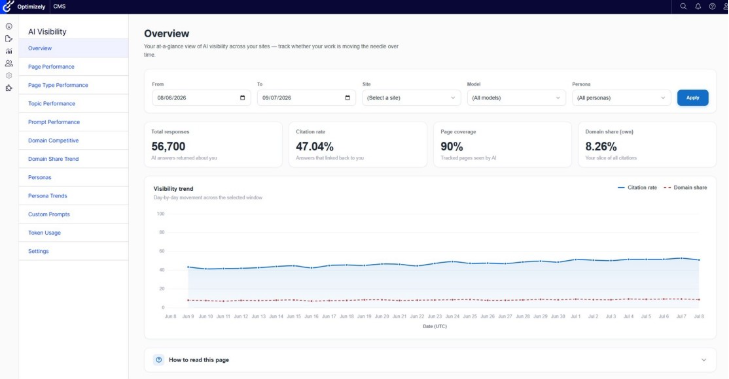
The Overview dashboard: citation rate, page coverage and domain share, tracked day by day, the feedback loop AEO/GEO has been missing.
That focus is deliberate, because it's built for a specific job: giving website owners a measurement framework for continuous AEO/GEO improvement. If your team is engineering and authoring pages to be more citable, restructuring content, sharpening answers, improving how a page type is built, you need to see the effect of that work at the level you're working: the page, the page type, the topic. Brand-sentiment platforms operate one layer of abstraction away from that and never expose it.
Showing that cause and effect, though, is only possible if the measurement understands your content, and the place that knowledge already lives is your CMS.
Built into the editor's workflow
So that's where we put it. Our AI Visibility tool is a package that installs directly into your Optimizely solution and brings measurement into the editor's workflow itself. There's no separate platform to log into and no disconnect between insight and action. An editor marks a page for measurement with a single toggle, and that page's visibility flows back into the same environment where they work.
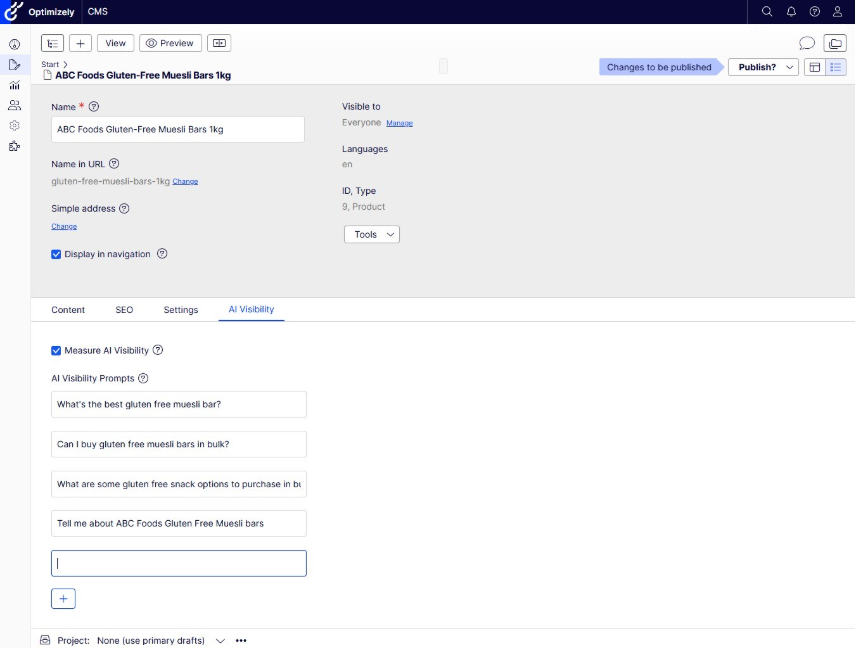
No separate platform to log into: the “Measure AI Visibility” toggle and its tracked prompts sit right on the content page itself.
Because it works from the inside, understanding your content model, not just your brand name, it can measure visibility at a level external tools simply can't reach:
- Whole website — your overall citation rate and share of voice across AI engines.
- Individual pages — exactly which pages are being cited, and which aren't.
- Page types — is your *Article* content outperforming your *Product* pages? Now you can see it.
- Topics — tag content by theme and track how your “sustainability” or “family travel” content performs as a body of work.
Crucially, it measures all of this across the major AI engines, ChatGPT, Gemini and Claude, each querying the live web, so you're not optimising for the quirks of a single model.
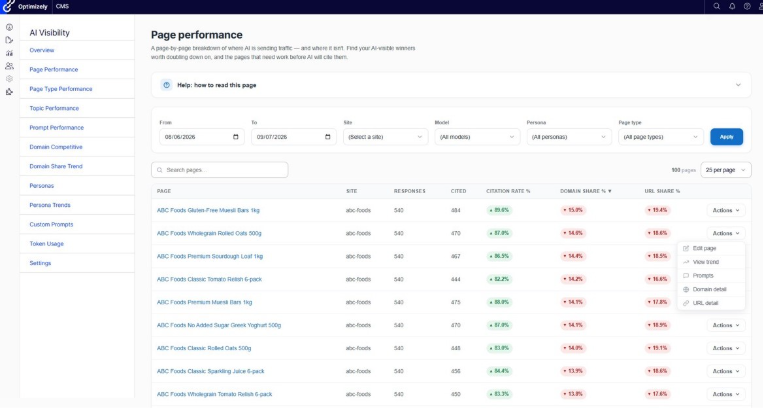
Page-level detail: exactly which pages AI engines are citing, and which ones need work before they will.
Your brand, and your competitors
Measurement isn't only about you. The tool builds competitive leaderboards from real AI responses, ranking the domains and specific URLs being cited for the queries you care about, with your own site highlighted. So when a competitor is winning the citation for a question you should own, you'll know the exact page that's beating you, and you can do something about it.
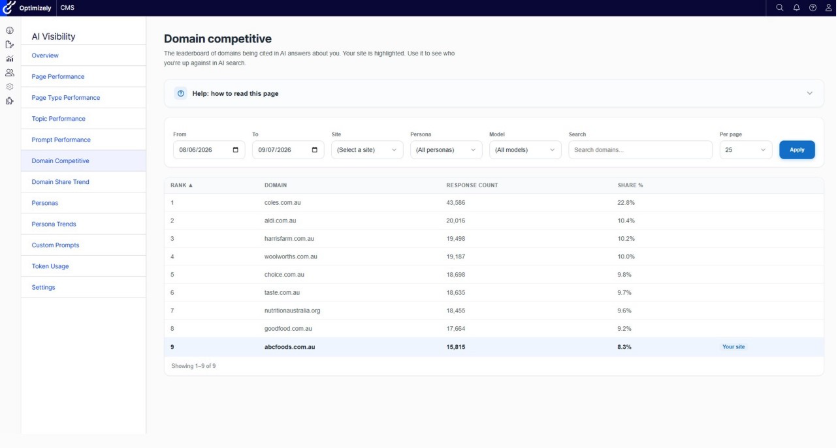
The competitive leaderboard: every domain being cited for your queries, ranked by share, with your own site called out.
And because every metric is tracked over time, you can finally close the optimisation loop: ship a change, watch your citation rate and share of voice move, and prove the return on your AEO/GEO investment with data rather than anecdote.
The takeaway
AEO and GEO aren't a future concern, they're already reshaping how customers find businesses. The teams that win will be the ones who treat AI visibility the way they once treated SEO: as something to measure rigorously and improve continuously. Doing that well means closing the gap between insight and action, bringing measurement out of a disconnected dashboard and into the place where your content actually lives.
That's exactly what we built.
Want to see AI Visibility working inside your own Optimizely environment? Get in touch with Orchard to arrange a demo.